

The analyses of some so-called Marxists and communists on social media show how quickly they betray internationalism by focusing solely on improving and reforming the conditions of the working class nationally, without ever tying domestic material conditions to exploitation and domination abroad, not to mention the domestic relations of power that revolve around of the axes of settler colonialism and racial capitalism. Methodological nationalism prevents people from thinking beyond their narrow nation-state frames of reference. Ultimately, it reflects a liberal and indeed fascist tendency in US politics, whereby the suffering of others is so easily disregarded, where what’s happening in Gaza is just another issue that detracts from the problems experiences by “Americans.”
This does not mean that politics from below, community organizing, and coalition building is insignificant. What I’m critiquing here is the reduction of politics to electoralism where reform becomes the end goal, not the destruction of interconnected systems of exploitation and domination.
Liberalism has saturated all spheres of social existence and constitutes the infrastructure of fascism and colonialism. Possessive individualism, whiteness, conquest, colonialism, imperialism, fascism, and racism are deeply entangled, despite those who deny their structural linkages. That’s why it’s not surprising that liberals of all shades have downplayed the genocide in Gaza, including those who self-proclaim to be more radical.
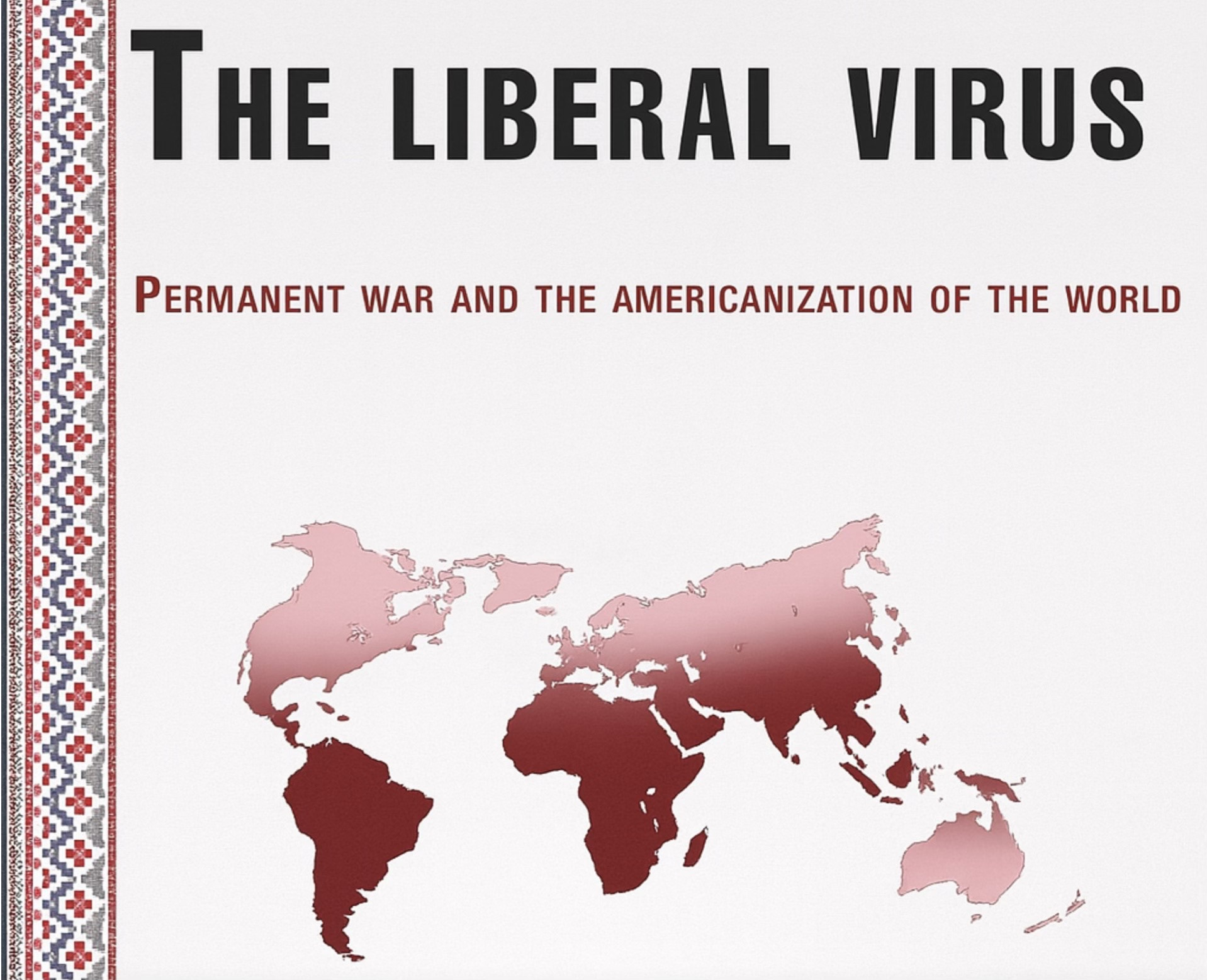
Samir Amin points out that liberalism requires that we act only within the limits of the capitalist system so we can “reform” it. He reminds us that “The reconstruction of a citizen politics demands that movements of resistance, protest and struggle” must eradicate this “liberal virus.” The myth of liberalism is believing that there are radically different political options when at the end of the day it’s all the same shit, especially for the Global Majority.
George Jackson’s critique of liberalism’s counterinsurgency is more relevant than ever. “When any election is held it will fortify rather than destroy the credibility of the power brokers.” Expecting that one day the dominant ethnoclass benefitting from colonialism and racial capitalism will “progressively” change (through elections) is one of liberalism’s greatest myths.
It’s for this reason Sara Ahmed points out how institutions may very well recognize harm but will do so only as a symbolic gesture without ever having to commit to transforming anything in material terms. This “non-performativity” only strengthens liberalism’s “affirmations and forgetting” without making structural change, which typically results in convincing the population that change is indeed on its way. This is what population-centered counterinsurgency looks like.
Historically speaking, the US’s liberal virus is a result of the settler colonial frontier and its possessive individualist logics and practices where settlers had freedom from restraint. We could only imagine what freedom from restraint meant to Indigenous peoples violently displaced and systematically killed, whose livelihood was destroyed with the killing of bison, for example. The latter is a foundational principle of liberalism. And if the frontier is merely the “outer edge of the wave” of colonialism, then one can rightfully assume that liberalism is the settler’s political culture, one that continues to justify colonial practices and dispossession at a global scale, and one that is increasingly seducing those on the receiving end as well, distancing them even further away from acquiring a revolutionary consciousness. As long as they benefit somehow, even if meagerly, then nothing and no one else matters, not even genocide as well as mass deportation and incarceration (ethnic cleansing).
The American psyche is a theater of shadows. Liberalism and conservatism, those twin masks of modern politics, stalk the stage like rival tragedians, each claiming the mantle of light while concealing their own abyss. To speak of one without the other is to mutilate the dialectic. Liberalism’s shadow is illusion; conservatism’s shadow is reaction. Yet both contain glimmers of light that, if integrated, might yield a politics of balance rather than perpetual war.
Liberalism, born of Enlightenment rationalism and the settler’s frontier, seduces with promises of progress. It whispers of universal rights, equality, and freedom, but its shadow is the endless deferral of justice. Reform becomes ritual theater, a spectacle of recognition without transformation. Institutions acknowledge harm only to bury it in symbolic gestures. Liberalism’s light is its pluralism, its capacity to imagine universality. But its shadow is the narcotic of reform, the liberal virus that convinces the oppressed that change is always “on the way,” never here.
Conservatism, by contrast, is the cult of continuity. It sanctifies hierarchy, tradition, and order, wielding fear of decline as its weapon. Its shadow is exclusion, the policing of bodies and borders, the denial of recognition altogether. Yet conservatism’s light is its reverence for memory, its insistence that community and belonging matter, that the past cannot be discarded like yesterday’s fashion. Where liberalism dissolves roots in the acid of individualism, conservatism reminds us that continuity is not always tyranny; it can be the thread that binds generations.
The dialectic demands we confront both shadows and both lights. Liberalism without conservatism drifts into abstraction, a cosmopolitanism that forgets the soil beneath our feet. Conservatism without liberalism calcifies into authoritarianism, a petrified order that suffocates dissent. The task is not to choose but to integrate: to seize liberalism’s universality without its reformist illusions, to honor conservatism’s rootedness without its exclusionary hierarchies.
Balance is not compromise; it is alchemy. It is the fusion of universality and rootedness, dissent and continuity, freedom and belonging. It is the recognition that politics must be both radical and careful, both transformative and sustaining. The dialectic of shadow and light is not a polite middle ground but a dynamic tension, a ritual dance in which opposites are held together until they yield a new form.
In this synthesis, freedom ceases to be possessive individualism or obedience to hierarchy. It becomes collective flourishing. Memory ceases to be the defense of domination; it becomes the archive of resistance. Change ceases to be reformist illusion or reactionary suppression; it becomes structural transformation grounded in community.
The American stage will always be haunted by its shadows — settler colonialism, racial capitalism, imperial conquest. But to dwell only in critique is to remain trapped in the theater of shadows. The dialectic of shadow and light demands integration, a politics that resists both liberal containment and conservative reaction, while weaving together universality and rootedness. Only then can we move beyond the endless spectacle of reform and reaction, toward a politics that is luminous, communal, and free.