

Du Bois wrote this piece during the Nakba in 1948. In this text, you will find the problematic views and colonial tropes used against Arabs and Muslims, which justified Zionist colonization to apparently bring development in the region and advancement of the Arabs, who Du Bois portrayed as despotic, ignorant, fanatic, and backward in need of civilization. It’s shocking to read this piece not necessarily because of the colonial tropes but because they were written by a scholar who had already published brilliant critiques of colonialism and its dehumanizing rhetoric. This doesn’t mean we should hastily dismiss Du Bois’ work. This would be a reactionary position. It simply means we should critique his work’s shortcomings and situate it historically.
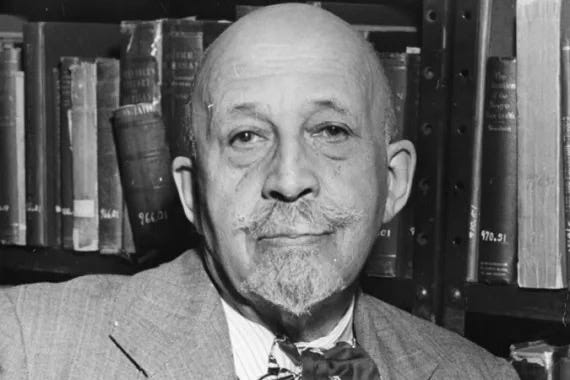
What is there right and wrong in the question of Palestine, which today faces not simply the United States but the whole world? It is not a difficult question. There is something terribly simple about it. Every child knows that ancient Jewish civilization and religion centered in Palestine. One has but to name its cities, rivers and places—Jerusalem, Bethlehem, Damascus, Jordan, Galilee and a hundred others. Everyone knows the way in which the history of the Jewish religion is wound about Palestine and from there how the thread runs through all modern history.
Palestine is a land largely of plateaus, mountains, and deserts, sparsely inhabited, and could easily maintain millions more people than the two millions it has today. Among the million Arabs there is widespread ignorance, poverty and disease and a fanatic belief in the Mohammedan religion, which makes these people suspicious of other peoples and other religions. Their rulership is a family and clan despotism which makes effective use of democratic methods difficult.
Now it happens that the Jew wandering through Europe has for two thousand years been fighting for a place. He was not allowed in mediaeval Europe, because of his religion, to pursue the ordinary vocations of most people. He became, therefore, a peddler and a financier, beginning his work with the new capitalism that arose in the Middle Ages. Here he found his vocation and served in every country.
There is no question of the contribution which he made to modern civilization, not only in banking and finance, but in the arts, in the fineness of his family life, in the magnificent clearness of his intellect. But he was faced always by three alternatives: Should he lose himself in the surrounding population and through that give up his peculiar culture and religion; should he keep to himself, an integral unit; or finally, should he try to find a state of his own? All three of these answers were made. Millions of Jews had lost themselves in the population of Europe and their blood mingles with that of other people’s.
At the same time they have kept a curious and fruitful unity in their culture and in their religion. Finally, after a bitter fight, there arose with increasing voice, a demand on the part of the Jews themselves that they should go back to Zion and refound the state which they had lost. This Zionism met opposition from many thoughtful Jews. They said this would increase anti-Jewish attitudes rather than decrease them. But the situation ceased to be academic. There began to be a growing feeling that certain of the Jews could only escape persecution by migration to a homeland.
Then during the First World War, on November 2, 1917, came the great promise of the British Empire: “His Majesty’s Government view with favour the establishment in Palestine of a national home for the Jewish people, and will use their best endeavours to facilitate the achievement of that object.” Moreover, this was no longer a mere question of religion and culture. It was a question of young and forward-thinking Jews, bringing a new civilization into an old land and building up that land out of the ignorance, disease, and poverty into which it had fallen; and by democratic methods to build a new and peculiarly fateful modern state. A start has been made in education, agriculture, water power, industry, and commerce.
Ernest Bevin, the Labor party’s Secretary of State for Foreign Affairs of Great Britain, building on some half-hidden dislike of Jews in his own mind, not only refused to carry out the British promise but used British troops against the Jews, trained Arab troops for use in the future against them, and used the Navy for keeping the displaced persons from migrating into Zion. In the United States, President Truman, after having promised to stand by the founding of Zion, inexplicably went back upon his word, refused to permit arms to be given to the beleaguered Jews in Palestine and since then has been trying to straddle the fence and make any efforts of the United Nations ineffective and impossible.
In the meantime, a million displaced Jews are begging to be allowed to migrate to Palestine, where there is room for them, where there is work for them to do, where what Jews have already done is for the advantage, not simply of the Jews, but of the Arabs. The British Navy is keeping the Jews out and when the British Navy ceases to act, the British trained Arabian Army will walk in and begin war. This may be the Third World War. If it is, the guilt of this final disaster of modern civilization lies upon the heads of Ernest Bevin and Harry Truman.
Du Bois was an elitist most of his political career. Ida B Wells regarded him as a conservative early in his phase in the Niagara movement and he had only just broken w Booker T Washington a few years earlier, and still advocated a ‘Talented Tenth’ approach to race progress. Supported black enlistment in First World War. He was radicalised during the Depression and produced Black Reconstruction, his best work, under the influence of Marxist materialism, but his elitism made Stalinism an attractive option in later years. A genius, no doubt, and a towering figure in Black politics, but problematic also. The Communist Party’s position on founding of Israeli state probably not a million miles from this to be honest. Stalin was looking for a counterweight to British power in the region, and assumed the Zionists were a ‘progressive’ force. Shambles, and a very problematic legacy for revolutionary politics in the region.
Thanks so much for this