

The only language that the enemy understands is the language of revolutionary violence.
—Popular Front for the Liberation of Palestine
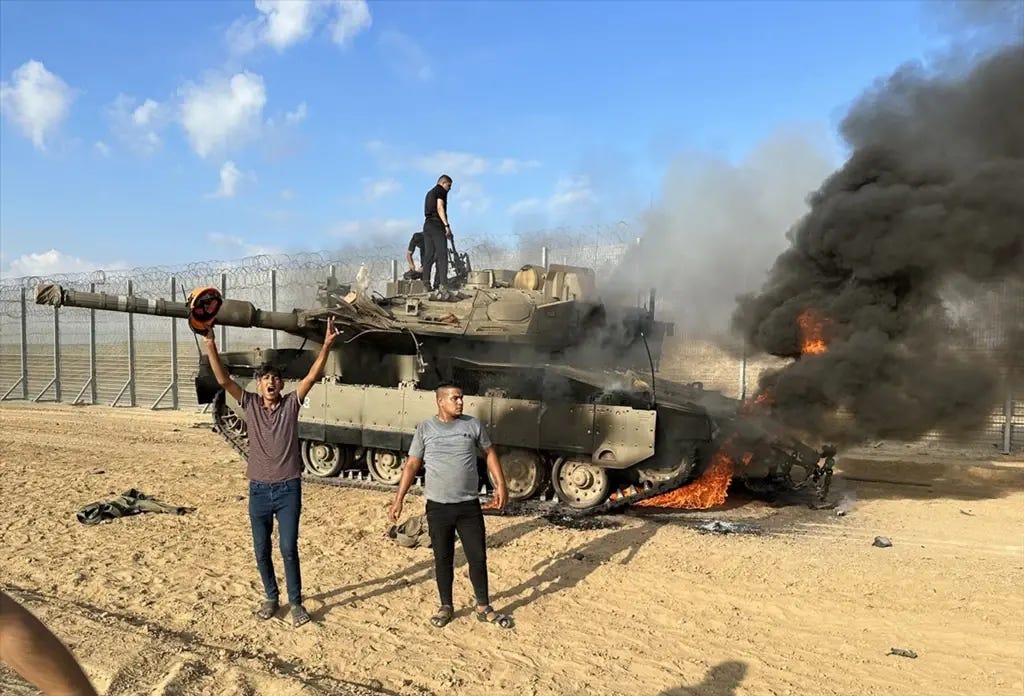
I want to focus my attention on what we witnessed on October 7, 2023, when the Palestinian resistance led an unexpected offensive after years of economic blockades, decades of settler colonial displacement, dispossession, ethnic cleansing, and several military campaigns resulting in incalculable suffering, death, and destruction in Gaza. As Max Ajl argues, Operation Al-Aqsa Flood was of world-historical significance, with direct implications for the United States and Israel, which he considers the least consolidated settler colonial state, an entity that constantly and increasingly depends on counterinsurgency to maintain its position of power in the region. This operation, as Ajl also notes, “brought into explosive combination yet larger forces, outside the territory of historic Palestine: The United States and the US-allied neo-colonial states alongside Israel” (p. 63). Palestinian insurgency thus brought to the world’s attention the ongoing struggle for total liberation, not only for Palestine, but for neighboring Arab countries dominated by puppet regimes.
Furthermore, the Palestine question reveals the long history of US-Israeli counterinsurgency. Ajl poses that Israel’s zionist settler colonialism, though it shares many characteristics with other settler colonial projects, there is “uniqueness” to its configuration since Israel represents a “condensation of Western colonial and imperial power, a world-wide symbol of Western perfidy, a state which physically cleaves Africa and Asia, a merchant and mercenary of global counter-insurgency, all melded in a manticore of death and destruction” (p. 63). Palestinian struggles for liberation thus pierce through the epistemological and political limitations imposed by US-Israeli counterinsurgent discourse and material arrangements that present settler colonialism as a fait accompli. Palestinian resistance peels off the ideological facade distorting reality by showing what total liberation from settler colonial dispossession takes. As Ajl writes,
“like lightning bolts of ever-increasing luminosity, they bring the relief of the world system into clearer view: the impotence of the United Nations; the imperialist contempt for international law; the complicity of the Arab neo-colonial states with Western capitalism; the fascist racism at the heart of modern European and US capitalism, as murderers and maimers operate in Western capitals; the neo-colonial structures of the Arab and Third World; and the hollowness of Western liberal democracy and its constellation of civil society institutions.”
Armed resistance against Zionist settler colonialism, Ajl reminds us, is resistance against imperialism, and, conversely the weakening of the latter implies the weakening of the former. US imperialism, understood “as a sociological phenomenon rests on the concrete practices of arms factories, counter-insurgency, surveillance, and the physical land bases and attendant stability needed for those processes” (p. 76), when weakened, means that capitalism’s structural genocidal project delivering premature death and total destruction is also weakened (Kadri). A nation that builds its capacity to defend itself against imperialist aggression is too often presented as wasting resources on what would otherwise assist in the social reproduction of said nation. That is the rhetoric used, for instance, to discredit the Palestinian Resistance as well as the discourse used to violate the sovereignty of Iran and its indigenous technologies used to resist imperialism. As Rubio stated on March 30, 2026, Iran Should Spend Money on Its People, Not on Military, which is ironic and hypocritical given that the Trump administration requested 1.5 trillion dollars for the Pentagon and 200 billion for its illegal imperialist war of aggression against Iran. Journalists and politicians have also joined the chorus by constantly referring to Hamas’ tunnel infrastructure, without which the resistance could not have engaged in a protracted struggle against the most powerful military forces in the world.
Kadri’s notion of the accumulation of waste, or, better yet, the accumulation through waste, conceptualizes the systematic shortening of living labour and the destruction of nature as yet another commodity that yields surplus value. Any form of insurgent resistance against empire-sanctioned death is an affirmation of life, despite the rhetoric used by stenographers of empire seeking to discredit resistance by portraying it as terrorism. On the other side of this coin is the “genocidal counter-insurgency and depopulation”1 of communities, countries, and regions that resist their annihilation. Gaza is certainly an exemplar case of imperialism’s and settler colonialism’s inherently genocidal project that accumulates capital through dispossession, death, and destruction. The genocide in Gaza demonstrates the relationship between the accumulation of waste, wasted lives, de-development, and surplus value. Its afterlife, if directed by the West, would signify not the end of the genocide, but its slower yet no less lethal administration.
For Kadri, imperialist wars are the purest forms of waste, “as a value forming activity whose saleable product is the premature death of labour” (p. 1). Imperialism’s ceaseless search for capital accumulation has reached a point where death and destruction of lives and nature can be commodified, whereby even the pollution and contamination of the planet can be exchanged like any other product (e.g., carbon trading comes to mind). The planet is undoubtedly divided between consumers in the North and those who are cannibalistically consumed in the South. Kadri considers this Manichaen world as one in which a necrotrophic process unfolds: on one side is the parasitic Global North, and on the other is the Global South host whose life-sustaining resources are extracted, polluted, and destroyed through genocidal imperial wars
On October 7, 2023, the Palestinian resistance affirmed life against zionism’s project of dispossession. It shattered the illusion of safety Israel’s US-funded technologies of colonial violence and surveillance had provided it for far too long. As Siddiqui2 writes, “Resistance to these structures pierces the illusion of projected inviolability and transcendental power, which are exposed as not just resistable, but indeed, even fragile. The Palestinian resistance, when they broke through their apartheid wall, also toppled the Zionist projection that the world must always be this way”. Breaking the seemingly indestructible physical wall of Zionist settler colonialism, however, would also create fissures in Israel’s dehumanizing racial discourse, unmasking what Palestinians have known for decades: that Israel is predicated on violence, territorial expansion, and racism (Sayegh, 1965). Israel’s and the US’s response after October 7 confirmed that they will stop at nothing to maintain imperialism’s accumulation of waste, that they will make an example of all those who affirm life through armed resistance. They are willing to destroy the material conditions to sustain life. As a pedagogy of domination, Israel’s genocide in Gaza aims to teach the world that resistance against imperialism anywhere will be met with annihilation. These aims, however, have not been fulfilled. The militant resistance against Israel and US imperialism has remained steadfast in the face of violence seeking to permanently destroy it.

1 Kadri J. (2023). Socio-historical roots of Yemen’s collapse. Springer Nature.
2 Siddiqui: in Fúnez-Flores eds in Decolonial Entanglements. Routledge